Monthly Archives: August 2014

The Shimshal Road (July 1st)

Weavers at Women's cooperative handicraft centre, Misgar village just north of Sost, Hunza Valley, Karakoram Range, PakistanThe following day we headed up the adventurous 55km Shimshal Road from the KKH and Passu. This road has a long and interesting history. It was built with a lot of local villager voluntary work over a 20 year period with some financial support from the Government of Pakistan and the Aga Khan Foundation.

It opened in 2003 and turned a 3-7 day journey on foot into a 3 hour drive. See history of the Shimshal road by David Butz, Brock University, Canada.

The road had been blocked by a rockslide 10 days earlier so we were not sure if we could get through to Shimshal that day. After one hour of driving the windy, narrow and exposed gravel road we came to the blocked area. There were at least 10 men working on repairing the road under the supervision of a government engineer. We were told that it would be at least another day before the road would reopen. It certainly did not look like the road was close to being finished. They were using dynamite to break up some overhanging rock to use as a base for the road and reduce the chances of further rockfall in the area.

We waited a couple of hours in the mid day sun to see if any opportunities opened up to get a ride to Shimshal from the far side of the blockage.

Fortunately a driver showed up from the Pasu side but had keys for a jeep on the Shimshal side of the blockage. All 8 of us loaded up the vehicle and headed happily to Shimshal. It was a great relief to get through the blockage because a big part of this trip’s objective was to spend some time with the shepherds at Shimshal Pass (4700m).We were concerned that we would not have enough time to make it there and back by foot.

We were very happy to arrive in Shimshal in the late afternoon after a number of challenging river crossings. Shimshal (3,000m) has a population of approximately 2,000 people living in 3 villages (Aminabad, Shimshal and Khizarabad) at the far end of the valley. These three villages consist of Wakhi speaking residents that support herds of sheep, goats and yaks that are moved up and down valley with the seasons.

Shimshal residents have hydroelectricity for approximately 5 months/year. There are current efforts being made to extend the hydroelectricity availability using a natural spring further down valley that does not freeze in the winter. Shimshal currently does not have any access to landline/ mobile or internet connectivity. The community has a satellite phone that is only used for emergencies.

The equivalent Local Support Organisation (LSO) for Shimshal is the Shimshal Nature Trust (SNT).

The previous government run dispensary in Shimshal was replaced in 2011 by a privately (German) funded and supported Shimshal Health Care Centre. This new Health Care Centre was built by the community with external funding from Misereor, Germany, Gesundheit fur Shimshal e.v Germany (Lisa and Horst Buschmann) with the support and advice from Nawbhar Education and Welfare Development Organisation(NEWDO),Shimshal.

The new Health Care Centre is bright, cheerful, quite spacious with running water, a birthing suite, consultation room, pharmacy area, and administration room. It is supported by a staff of 5 people i.e. Dispenser, LHV, Midwife, Assistant Nurse and Administrator. The Dispenser, Mr Farman Ullah has been providing medical care to his community for the past 36 years. He has and continues to be a real asset to his community. The administrator Mr Zulfiqar is very competent, motivated and also very active as a community leader including SNT.
June 30 – BHI to Fund Training of LHV/Midwife in the Misgar Valley

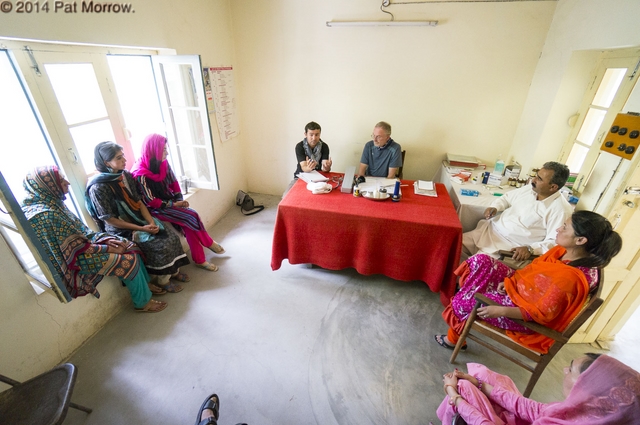
Bill Hanlon, Basic Health Int'l, and KADO rep Imran Khan interview potential health trainees, Misgar village just north of Sost, Hunza Valley, Karakoram Range, PakistanThe following morning we drove the 23 km north and west to Misgar. The approach to Misgar village is especially beautiful this time of the year. The fields were vibrant with wheat/barley and alfalfa crops with snow capped peaks towards Mintaka and Kilik Passes in the background. The water in Misgar is very pure. It looks so clear as it runs through the human made channels throughout the village.
We had a breakfast meeting with Mr Abdullah and the LSO coordinator and board member at his home in Misgar. He has a beautiful garden, full of vegetables and fruit trees.

Misgar is an oasis in a very dry mountain landscape. In many ways it is a model village in their agricultural practices and community support/engagement.

We visited the Misgar Dispensary with Mr Abdullah. He now has a medical technician working with him.

He appeared to have quite a good supply of medicines and dressings.

There is currently no LHV/midwife working in Misgar. All pregnant women have to travel to Sost to deliver their babies.

Intermittently, the 16km gravel road from Misgar to the KKH gets blocked by mud/rock slides and occasionally snow in the winter months.

BHI has agreed to spend up to 480,000 rupees (20,000 rupees/month x 2yrs) towards the training of one selected candidate from the Misgar Valley to complete the combined LHV/Midwife 2 year program at the Aga Khan University in Karachi. The selected candidate will need to commit to working in the Misgar Valley for a minimum of 3 years after completing the program.

We met with some LSO representatives and 4 potential candidates for the LHV/midwife training program.

We explained that the position would be open to all candidates from the Misgar Valley. The selection of the candidate should be fair and transparent and go to the best qualified applicant. The selection should come from the LSO and confirmed by KADO and BHI.

Misgar village has landline phone access but no mobile phone or internet connectivity yet. We discussed e-health possibilities once there is connectivity in the future. We did discuss the possibility of e-health training for health workers from Misgar at the KADO IT Centre in the future.

We also met with two Basic Health Workers, one works in a room attached to her home in the main village(where we met) and the other is assigned at the lower end of the village. They help with vaccinations and mother/child care in their community.

We then visited a Female Youth Vocational Training Centre. The program has been operational for 6 months and is run by a very enthusiastic female teacher. They have a number of sewing machines that help produce their clothing products. With Imran’s help, we discussed developing a marketing plan once the products are made. Imran indicated that KADO could help with a marketing program and training.

We then visited a Women’s Carpet Making Centre and viewed some of their fine products. They would also benefit from more education in the marketing area.

We visited the old British built Post Office. It was built in 1915 and is still operational today as a post office. Misgar was historically part of the old Silk Route for caravans of human and animal movement over Mintaka and Kilik Passes into Central Asia.

We tried to arrange a visit with shepherds at Mintaka(4827m) and Kilik Passes(4726m) prior to our arrival.

Unfortunately both areas are closed to westerners for polital/security reasons.

We returned to Sost later that day.

June 29 – Onwards Down the Chipursan Valley

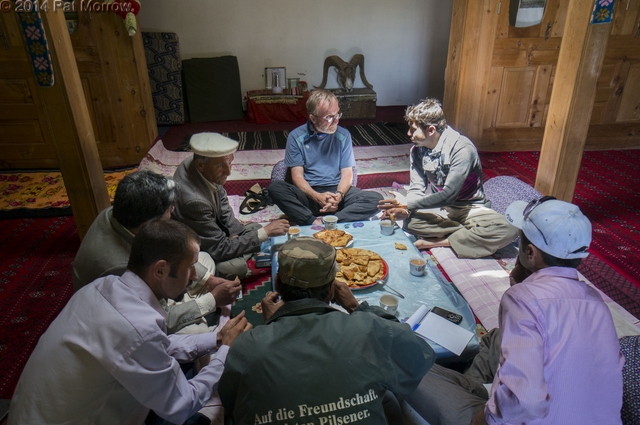
Bill Hanlon, Basic Health Int'l, and KADO rep Imran Khan meets with community leaders in Sharisabaz, Chipurson Valley, tributary of Hunza Valley, Karakoram Range, PakistanThe following morning we left Alam Jan and his family and headed down valley.

We had a very productive meeting with the chairman and other board members of the CLSO at Spenj.

We discussed many topics including the selection of a LHV/midwife (one person) from the Chipursan Valley. We discussed the criteria for the selection process.

BHI is prepared to spend up to 480,000 rupees (20,000 rupees/month x 2yrs) towards the training of one selected candidate from the Chipursan Valley to complete the combined LHV/Midwife 2 year program at the Aka Khan University in Karachi. The selected candidate will need to commit to working in the Chipursan Valley for a minimum of 3 years after completing the program.

We also discussed the setting up of an LED lantern manufacturing and marketing microcredit program in the area.

Samples of a Canadian designed, affordable LED lantern donated by Faith and Anthony Harkham of Canmore, Alberta, Canada was left at the Aga Khan Health Centre. This is a template to base future customised designs from the area. In the meantime the health centre staff can use it when their power is out.

Mubeen, CEO of KADO made the very practical suggestion that they add a mobile phone charging outlet to the device.

We discussed ways to increase vegetable and fruit production in the Chipursan Valley, taking into account its higher elevation and longer winters. We discussed different affordable greenhouse designs, based on my experience working with Cynthia Hunt in Ladakh.

We completed the meeting with an agreement that the CLSO would select the LHV/Midwife candidate and report back to KADO who would confirm with BHI before announcing to the selected candidate and community.

We then moved on to a meeting with the health care staff at the Aga Khan Health Centre. There are two very competent health care staff currently working at the AKHC. There is a Community Health Nurse and LHV. Both are experienced and contribute a lot to their community. Currently there is no internet connectivity in the Chipursan Valley, so e-health support is not an option at present. We discussed future e-health possibilities once internet connectivity becomes available including health care staff accessing the KADO IT program at Gulmit. We arranged to have a LED lantern left at the centre.

We had a long discussion re current health issues in Chipursan Valley. More common medical conditions seen included hypertension, bronchitis/pneumonia (especially winter), gastritis, anemia, eye and skin infections. There were no recent cases of TB reported.

A very concerning issue was the recent increase in depression and suicide among young adults especially. There were 9 suicides reported in the Chipursan Valley in the previous 3 months. This is very concerning. There appeared to be an increase in associated domestic violence and alcohol use. The staff at the HC do provide an ongoing counseling service for people with depression and anxiety. However, they do not have access to antidepressant or anti-anxiety drugs. People need to travel to Gulmit or Gilgit to access such services. BHI is certainly willing to work with the CLSO on exploring ways to improve access to mental health services for the people of Chipursan Valley. There is an urgency in this matter to prevent further preventable, unnecessary deaths in the area.

We then traveled back down valley to the KKH and then onto Sost. There we had a meeting with Mr Abdullah the Dispenser in Misgar. He also has a medical clinic in Sost. We met him at his office in Sost.

We discussed current health issues related to the people of Misgar Valley and future health needs of the Misgar area. The current population of Misgar Valley is approximately 1,500 people. It lies approximately 23km from Sost, 16 km of which is a narrow gravel road up valley.

We visited the busy Aga Khan Health Centre at Sost. Currently they have no doctors working at the centre.

There is currently a community health nurse and LHV working at the Sost Health Centre. They are responsible for all the medical care in the area. With the expansion and upgrading of the KKH the Sost Health Centre is much busier. The number of road traffic accidents has increased significantly with more vehicles and increased speed. Most people riding motor bikes do not wear helmets.

When I visited the Sost HC in September 2013 they had started an e-health program. With the loss of a doctor the program is currently not operational. I discussed with the Sost staff the future e-health program at the KADO IT centre in Gulmit. The Aga Khan Health Services has an expanding e-health infrastructure already in place. Hopefully Sost will get a doctor again soon and a more vibrant e-health program could be reactivated and expanded in Sost. The existing staff at the Sost HC would benefit from reactivating the program now.

A Visit with Alam Jan Dario, eHealth, Schools, Community Health and More

Amran Jan Dario''s wife Haji Bibi and child, Zood Khun village, Chipurson Valley, tributary of Hunza Valley, PakistanThe following day we crossed the Atabad Lake heading north to Shimshal.

We had a good meeting with the director of the KADO IT Centre in Gulmit. We met with a new class of young students who were participating in a business IT program. We discussed with the director about BHI’s willingness to help fund a part time teacher to provide an e-health component to their general IT course. He agreed to work out a budget for such a program. After crossing the Lake we heard that the Shimshal road was temporarily closed due to a recent rockslide. At short notice, after meeting our great driver Sajjad on the far side of the lake, we decided to head to the village of Zood Khun, the last of eleven villages at the far end of the Chipursan Valley.

As the day light was fading, approaching the village of Zood Khun we met Alam Jan Dario heading by jeep in the opposite direction. Alam Jan is a great musician, poet, community leader and friend. In typical Hunza style, he joined us as we headed to a group of shepherds camped in a pasture beyond Zood Khun. The shepherds spend most of the daylight hours with their sheep/goats and yaks in the high country looking for good pasture and bring down their animals in the early evening so they can protect them from predators such as wolves, foxes and snow leopards.

We had a good discussion re: health issues with the shepherds over a cup of chai. As light was fading, we headed back to Alam Jan’s house for the night. We met his mother, wife and the rest of the family, had a lovely traditional meal and spent the night at his home.

His hospitality is well known. He has started planting fruit tress such as apricots/cherries/apples and mulberries and looking into a simple greenhouse design to extend the growing season for vegetables.

Chipursan Valley is colder and higher than Misgar and more difficult to grow fruits and vegetables.

Alam Jan has shown that it is possible to grow fruit and vegetables in this area. Hopefully his actions will inspire other families in the area to pursue similar activities.

The following morning we went back to visit the shepherds in daylight and did some health assessments and discussed nutrition and general health issues, especially those centred around close animal and human contact. It is important to be flexible with clinical evaluation times as the shepherds leave around 7.30 am and don’t get back to their camp until around 5.30pm.

Later that day we visited the local CAI built high school and met with students and teachers. CAI currently funds 2 teachers and AKS runs the school. Schools like this would very much benefit from internet connectivity. Hopefully it will happen soon. This school also has a good working relationship with parents.

In the afternoon Alam Jan and I visited the home of community health worker Aziza and her family.

She has been working in her community for over 20 years. She runs a dispensary service from an adjoining room attached to her house. She is available 24/7 without any backup help. She appeared to have a good supply of medicines which are restocked every 6 months by the government. She does see some Kyrghiz nomads from the Wakhan seasonally when they come across to trade via Baba Ghundi. We discussed possible ways we could support this initiative.

Our Journey Begins

Bill Hanlon, Basic Health Int'l, and KADO rep Imran Khan interview shepherds during mobile health clinic near Zood Khun village, Chipurson Valley, tributary of Hunza Valley, PakistanOur trip started out on an adventurous note, with a political diversion to Lahore for 15 hours and eventually arriving in Islamabad 15 hours later than expected. We caught a few hours sleep and then drove up the Karakorum Highway (KKH) for 2 days with many army roadblocks along the way.
On arrival in Gilgit, we had a very productive meeting with Dr. Zaeem Zia, a John Hopkins trained local physician who was conducting a series of training sessions for village medical technicians. Dr. Zia has been very supportive of our work in Hunza.

We both felt a great sense of calm as soon as we arrived in Karimibad (Hunza). That magnificent vista down valley towards Rakaposhi, the cooler and less polluted air and the great hospitality of the Hunza people worked wonders in relaxing and comforting our exhausted aching, aging bodies!

We got the opportunity the first evening in Karimibad to meet the chairman and some board members of KADO.

The following morning, I had a productive meeting with Ms Zadia Zia the current Minister of Tourism for Gilgit/Baltistan. We discussed ways to improve the travel experience for western tourists visiting Hunza and ways to encourage more visitors to come in a safer way. We discussed the possibilities of coming in from Kashgar on the China side. She had indicated that preliminary talks had already taken place to develop a more active tourist corridor between Kashgar and Hunza. Improving the economic status of the residents of Hunza through improving employment in the tourism area would help improve the overall health of the people of Hunza. Hunza has a large number of well educated young adults that would thrive in a robust tourism economy. This would keep more young adults in the Hunza area and reduce the need to travel to the cities for low paying jobs.

We then had a meeting in Aliabad with Amjad (Chairman), Mubeen (CEO) and other members of the KADO team to discuss our work plan. Many good ideas/recommendations came from this meeting

KADO agreed to allow Imran Khan travel with us as interpreter and guide. Imran was a great asset to our team and worked diligently to make the trip successful.

We then met with the Government of Pakistan District Health Officer Dr. Sher Hafiz. We discussed many local health issues and ways we could work collaboratively in the future. In particular, we discussed the TB situation in the Shimshal Valley and discussed previous studies, the estimated prevalence and possible ways we could work together to try to eliminate the problem from the Shimshal Valley.

Hunza, Pakistan – June/July 2014

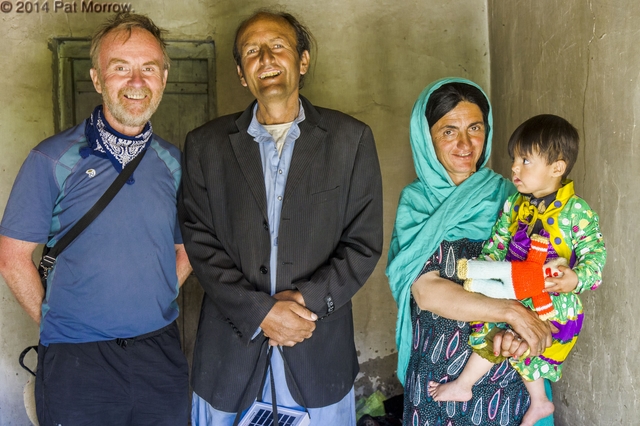
Amran Jan Dario, poet, musician, guide, with family and Bill Hanlon, Zood Khun village, Chipurson Valley, tributary of Hunza Valley, PakistanIn June/July 2014, Dr. Bill Hanlon, Founder and Medical Director of Basic Health International Foundation returned to Hunza in north east Pakistan to build on existing medical programs and expand it’s work into more remote areas such as the Shimshal summer pastures at 4700m, Chipursan Valley (3500m), Misgar Valley (3075m) and the Batura Glacier (Yashpirt 3302m) summer pastures.

The work was done with the cooperation and support of the Karakorum Area Development Organisation (KADO) and the HiMaT Indigenous Leadership and Development Program/Michael and Judie Bopp

Dr. Hanlon was accompanied by internationally renowned Canadian photographer and mountaineer Pat Morrow who documented the trip with video and still images.

The objective of BHI is to work with local communities and organisations (LSOs) to improve the quality of health care in remote communities across the region.

The focus of this trip was to travel into the very remote areas of Shimshal Pass (Pamir at 4700m), Batura Glacier summer pasture, the far end of Chipursan Valley and Misgar Valley in upper Hunza and carry out health assessments of all nomads working with their animals in the pasture and provide some health education in the field.

The long term objective is to establish an effective health care link between people in the remote pasture areas, local village community health centres and regional specialist secondary and tertiary care services.

To better understand the current health issues facing nomads living in such remote areas, I felt it was important to spend some time with the nomads in their work environment.

These areas had never been visited by a physician. Traditionally mostly women live high in the summer pasture of Shimshal Pamir (4700m). They travel up in May each year and return end of September/early October. During this time, they have no access to any form of medical care.

Traditionally a group of men from the lower Shimshal villages spend winter in the pasture areas without any access to healthcare and surviving in difficult winter living conditions.

BHI is working on establishing e-health linkages between remote village community health centres and regional specialist services. The hope is that these linkages will expand to support people working with their animals in the more remote pasture areas with the help of satellite technology.

Ideally, a person in the early stages of acute appendicitis working in the pastures could be given early advice and support to come down to the nearest surgical service. Unfortunately a shepherd died last year in the Pamir from acute appendicitis. He did not have access to health care.