Tag Archives: World Travels

Hunza, Pakistan – June/July 2014

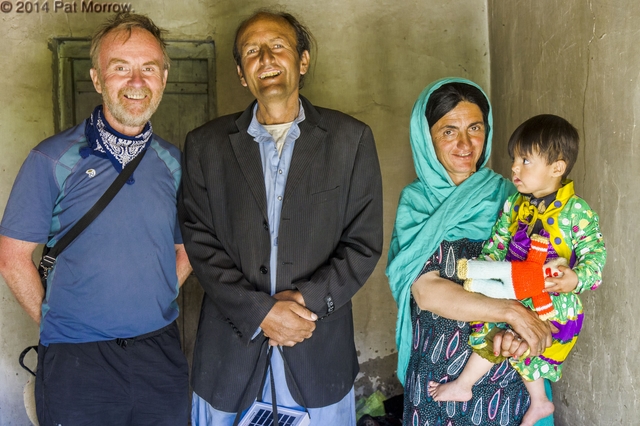
Amran Jan Dario, poet, musician, guide, with family and Bill Hanlon, Zood Khun village, Chipurson Valley, tributary of Hunza Valley, PakistanIn June/July 2014, Dr. Bill Hanlon, Founder and Medical Director of Basic Health International Foundation returned to Hunza in north east Pakistan to build on existing medical programs and expand it’s work into more remote areas such as the Shimshal summer pastures at 4700m, Chipursan Valley (3500m), Misgar Valley (3075m) and the Batura Glacier (Yashpirt 3302m) summer pastures.

The work was done with the cooperation and support of the Karakorum Area Development Organisation (KADO) and the HiMaT Indigenous Leadership and Development Program/Michael and Judie Bopp

Dr. Hanlon was accompanied by internationally renowned Canadian photographer and mountaineer Pat Morrow who documented the trip with video and still images.

The objective of BHI is to work with local communities and organisations (LSOs) to improve the quality of health care in remote communities across the region.

The focus of this trip was to travel into the very remote areas of Shimshal Pass (Pamir at 4700m), Batura Glacier summer pasture, the far end of Chipursan Valley and Misgar Valley in upper Hunza and carry out health assessments of all nomads working with their animals in the pasture and provide some health education in the field.

The long term objective is to establish an effective health care link between people in the remote pasture areas, local village community health centres and regional specialist secondary and tertiary care services.

To better understand the current health issues facing nomads living in such remote areas, I felt it was important to spend some time with the nomads in their work environment.

These areas had never been visited by a physician. Traditionally mostly women live high in the summer pasture of Shimshal Pamir (4700m). They travel up in May each year and return end of September/early October. During this time, they have no access to any form of medical care.

Traditionally a group of men from the lower Shimshal villages spend winter in the pasture areas without any access to healthcare and surviving in difficult winter living conditions.

BHI is working on establishing e-health linkages between remote village community health centres and regional specialist services. The hope is that these linkages will expand to support people working with their animals in the more remote pasture areas with the help of satellite technology.

Ideally, a person in the early stages of acute appendicitis working in the pastures could be given early advice and support to come down to the nearest surgical service. Unfortunately a shepherd died last year in the Pamir from acute appendicitis. He did not have access to health care.

Spring 2014 Greenland Crossing

In Spring 2014 Bill Hanlon, Mari Rodness Vesteras from Norway, Sanna Kallio from Finland, Gareth Collier from the U.K., Gunnar Holien, Peter Angell Moen, both Norwegian, and Guide Are Johansen teamed up to cross Greenland on foot (well, on ski to be exact).

They succeeded, unsupported, covering  approx 600km in 24days.

Read more about the adventure on Børge Ousland’s site.

Also, be sure to check out our own pictures in our gallery.


Recent Nepal trip

Just back from a trip to the Manaslu area of Nepal.This region sits between the Everest and Annapurna area.It was officially opened up to westerners in 1991.Val Pitketly, Pasang and I along with 6 porters carrying medical supplies, clothing and our gear hiked into the Tsum Valley.It is a beautiful area, sculpted by the great Ganesh Mountain Range.The land is less fertile than the approach.People in the area have limited food supply and less access to medical care.We visited a community health centres in Philim and the Tsum Valley.The people of the Tsum Valley are Tibetan.We met with very competent and dedicated community health workers at both locations.I got the opportunity to share experiences, do some teaching + clinical work at the community health centre.We brought a supply of medications and clothing for the children.It was a great experience for all of us.Saw a young infant with 2nd degree burns to the saddle and buttock area after falling into a pot of hot cooking oil,near an open fire.Unfortunately,this is quite a common problem with open fires in people’s houses.we debrided the wound and started the infant on antibiotics.I checked back about a week later.Glad to say the infant was doing much better and should make a good recovery.

Doctor reaches Tibetan Plateau

[WTN-L World Tibet Network News. Published by The Canada Tibet Committee. Issue ID: 2003/12/28; December 28, 2003.]

Wednesday 24 December
By Samara Cygman

A Cochrane doctor weathered altitudes of 14,000 feet, exposure to potentially fatal diseases and having to drink yak-butter tea for one month to deliver desperately-needed health care, vitamins and education to locals in one of the most isolated regions in the world – the Tibetan plateau.

Dr. Bill Hanlon, family physician at the Cochrane Medical Clinic, returned home Dec. 6 from his Tibet Child Nutrition and Multi-drug Resistant Tuberculosis project, where he and an American colleague, Dr. Nancy Harris, worked on improving the nutritional and general health status of the children of Tibet by introducing a western approach. They have a huge problem with nutrition, poor sanitation, poor hygiene, a lot of problems with infectious diseases, problems with Ricketts a lack of vitamin D and calcium so people get stunted in growth and a lot of developmental problems. We saw a lot of stunted children, well below their ideal weight and height, many with thin, discoloured hair, thin limbs and protuberant bellies, recounted Hanlon. Those are conditions we don’tt see much here anymore. We helped deliver visual charts with a balanced nutrition message, a hygiene message and ways to recognize symptoms of tuberculosis and treatment options. They even worked with a local musician to create a series of songs about hygiene and the importance of hand-washing and covering your mouth when you cough. By the hundreds, children filed past Hanlon, afflicted with illness ranging from inactive thyroid glands causing goiter in the neck, chronic diarrhea, pneumonia, measles and tuberculosis. Tuberculosis was an area I was interested in. They have a lot of resistant tuberculosis to a lot of medicines we use, said Hanlon, adding a lack and improper use of medicines have resulted in the resistant strains of TB. But it is one of the most treatable infectious diseases in the world. Which is what he found about most of the illness he saw. Not only treatable illness, but entirely preventable illness, ran rampant through the population. One man had a stroke and I was asked to see him. He had a very high blood pressure and it was sad because it was totally preventable, said Hanlon, who worked with the 70-year old every morning to get his blood pressure down. He and his family are very gracious and kind, insisting I have some tea. Yak-butter tea is very much an acquired taste, he laughed, adding it was salty, and likening it to warm soup. Protecting himself against infectious diseases was a bit of a challenge. He had to get shots for rabies, diphtheria, tetanus, Hepatitis A and B and Typhoid.

Hanlon tries to go on this kind of vacation (as he jokingly called it) at least once a year, with all the funds coming out of his own pocket. I’ve always had an interest in this and it helps balance the life we have here with the rest of the world, he said. To help deal with the illness and disease Hanlon and Harris handed out multi-vitamins, nutritious food, medicine and information to almost everyone that came to see them. The impact of small intervention is huge. It can have a huge impact on people’s lives, said Hanlon, adding it was even more important than high-tech machines like MRIs.

His colleague, Harris, who has been living off and on in Tibet for 14 years, was published in the New England Journal of Medicine when she found out 60 per cent of the children she saw had Ricketts. To combat this disease, mainly caused by a vitamin and protein deficiency, Harris had a local plant, Droma, analyzed in the United States and found it worked as a high-protein supplement. It was ground up into flour and distributed amongst the families. The problem with people is they don’t have enough variety in their diets, said Hanlon, adding they mainly eat high carbohydrate, low protein diets that are also low in fruit and vegetables. But depending on the season, their access to fruit and vegetables is sporadic at times. To help the people on a more permanent basis, Hanlon was proud to announce his new federally-registered Basic Health International Foundation. The foundation aims to support public health and primary health care programs in high-need, remote locations and more specifically, high-altitude locations.

I love the mountains, so it s an area of interest, said Hanlon, adding the registered charity took almost a year to set up. This is just another stage in getting ongoing commitment to that area. His intent is to keep the foundation small to incur less administrative costs and accountable and self-sustaining by the population it serves.

A web site will be up and running in the new year. Tibetans are a wonderful group to be with. I very much enjoyed their humour, sense of compassion and spirit of giving, said Hanlon. At this festive time of taking trips to the mall and holiday parties, perhaps we can think a little more on those in greater need.

Cochrane Times
reprinted in Tibet Environmental Watch

Anniversary of Everest ascent meaningful

by Larry Giles

The 50th anniversary of Sir Edmund Hillary’s climbing of Mt. Everest this Thursday is a big reason to celebrate for at least one Cochrane doctor.
Dr. Bill Hanlon travelled to the Kathmandu region of Nepal in April, working at a clinic in the capital city most widely known as the entry point for climbers planning an Everest ascent.
As an expedition to the summit can take more than two months factoring in time to acclimatize and the 10-day trek just to reach the base camp, Hanlon was there when many of the climbers planning to summit on the 50th anniversary were starting out.
But for the Cochrane physician, the first ascent on May 29, 1953 was a significant event, not just for the climb but also for the legacy Hillary and his sherpa TenZing Norgay have left.
Hillary is known in the region for his humanitarian efforts and has built medical facilities and schools in the country. Nepal has been isolated from the world for so long and is now struggling to catch up, says Hanlon who was intrigued by the two extremes of Nepal, which is actually one of the poorest countries in the world.
“It is a country where you can get an MRI scan in Kathmandu within 30 minutes if you can afford the $200 and yet have difficulty getting an aspirin in many of the rural communities outside of Kathmandu.”
The elevation, isolation and rapid change in Nepal makes it an interesting study for Hanlon, who enjoys learning about other cultures both socially and medically.
He was there during the initial outbreak of SARS, which caused great concern for the medical community in Kathmandu.
One of the primary access points to Nepal is via Hong Kong, which is where the virus has been a major problem.
The availability of masks and other preventative measures was of concern, but so were the ramifications of an actual case or worse yet, a larger outbreak.
“There are only two or three ventilators in the entire country…the infrastructure to support a patient (including a quarantine facility) is not really there.”
Hanlon’s recent trip to Nepal was not his first. He had trekked the area in the 1980s and at that time had made it to the base camp for Everest expeditions.
He finds the medical challenges in developing countries of interest and enjoys the similarities between the mountain communities west of Calgary and others around the world.
There are many medical ties between Calgary and Kathmandu including a few international development projects between the University of Calgary and Nepal’s Tribhuvan University. In fact the present head physician at the Nepal International Clinic completed some of his training at the U of C.
Many of the ailments at the clinic Hanlon was working at related to altitude sickness. The Cochrane townsite sits at an altitude of 3,500 feet and the top of the Big Hill at about 4,000 feet with some of the highest peaks in the Rockies reaching close to 12,000 feet.
In Nepal, many of the passes reached by trekkers are more than 14,00 feet above sea level with some of them as high as 16,000 feet, all of which is still below where any of the true mountain climbing actually begins.
“There is some challenging medicine coming off the mountain. Certainly altitude sickness takes its toll every year…people die on that mountain and they die just trekking there too.”
One of the issues that has been discussed in the area is setting up a clinic for the porters, which are the locals who carry the majority of supplies to Everest base camp and beyond. It is the porters who do the grunt work in a harsh environment for relatively little pay and one did die while Hanlon was in the area.
All the money generated in the region by tourism brings both positives and negatives, Hanlon says. The country is not heavily populated but the mountainous terrain means little land is available for agricultural purposes. As the tourism money is generated only in the Kathmandu valley and the popular trekking routes, it is difficult for an average family to advance beyond the basics of everyday necessities.
And yet people have a strong interest in education and will walk long distances to make sure their children get to school so that they may have a chance at a better life.
The people of Nepal are also extremely tolerant.
“It is a country where Buddhists, Hindus and Christians live together. Nepalis have accepted and live in harmony with Tibetan and Bhutanese refugees,” he says. Tradition-ally their culture has been deeply rooted in spirituality and less on the material.”
Before returning to Cochrane, Hanlon attended the International Society of Travel Medicine meeting in New York, but it was what he saw while in New York that struck him. The contrast between limousine travel in Manhattan to people sleeping in doorways in the lower East Village was huge for him.
“What is the true meaning of success in life and how do we define it,” he asks. “Is it getting to the top of the corporate ladder or the top of a mountain?
“In our efforts to climb our respective peaks in life we sometimes lose track of the price we have to pay to reach our goal…Just as the people of Nepal look to us for direction and change, we can also learn from them in the area of compassion, tolerance and generosity towards strangers as well as friends.”