Tag Archives: Fundraising

Hunza, Pakistan – June/July 2014

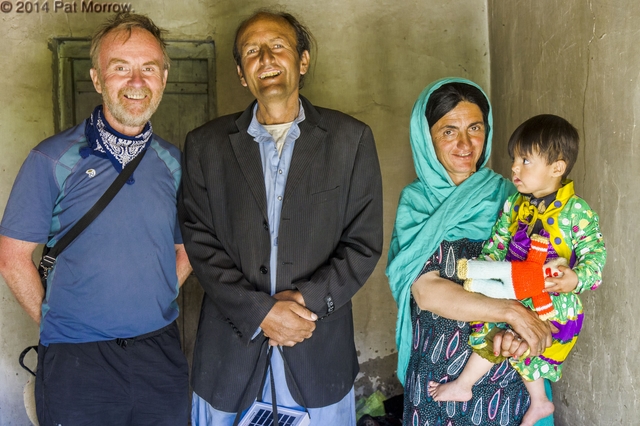
Amran Jan Dario, poet, musician, guide, with family and Bill Hanlon, Zood Khun village, Chipurson Valley, tributary of Hunza Valley, PakistanIn June/July 2014, Dr. Bill Hanlon, Founder and Medical Director of Basic Health International Foundation returned to Hunza in north east Pakistan to build on existing medical programs and expand it’s work into more remote areas such as the Shimshal summer pastures at 4700m, Chipursan Valley (3500m), Misgar Valley (3075m) and the Batura Glacier (Yashpirt 3302m) summer pastures.

The work was done with the cooperation and support of the Karakorum Area Development Organisation (KADO) and the HiMaT Indigenous Leadership and Development Program/Michael and Judie Bopp

Dr. Hanlon was accompanied by internationally renowned Canadian photographer and mountaineer Pat Morrow who documented the trip with video and still images.

The objective of BHI is to work with local communities and organisations (LSOs) to improve the quality of health care in remote communities across the region.

The focus of this trip was to travel into the very remote areas of Shimshal Pass (Pamir at 4700m), Batura Glacier summer pasture, the far end of Chipursan Valley and Misgar Valley in upper Hunza and carry out health assessments of all nomads working with their animals in the pasture and provide some health education in the field.

The long term objective is to establish an effective health care link between people in the remote pasture areas, local village community health centres and regional specialist secondary and tertiary care services.

To better understand the current health issues facing nomads living in such remote areas, I felt it was important to spend some time with the nomads in their work environment.

These areas had never been visited by a physician. Traditionally mostly women live high in the summer pasture of Shimshal Pamir (4700m). They travel up in May each year and return end of September/early October. During this time, they have no access to any form of medical care.

Traditionally a group of men from the lower Shimshal villages spend winter in the pasture areas without any access to healthcare and surviving in difficult winter living conditions.

BHI is working on establishing e-health linkages between remote village community health centres and regional specialist services. The hope is that these linkages will expand to support people working with their animals in the more remote pasture areas with the help of satellite technology.

Ideally, a person in the early stages of acute appendicitis working in the pastures could be given early advice and support to come down to the nearest surgical service. Unfortunately a shepherd died last year in the Pamir from acute appendicitis. He did not have access to health care.

Spring 2014 Greenland Crossing

In Spring 2014 Bill Hanlon, Mari Rodness Vesteras from Norway, Sanna Kallio from Finland, Gareth Collier from the U.K., Gunnar Holien, Peter Angell Moen, both Norwegian, and Guide Are Johansen teamed up to cross Greenland on foot (well, on ski to be exact).

They succeeded, unsupported, covering  approx 600km in 24days.

Read more about the adventure on Børge Ousland’s site.

Also, be sure to check out our own pictures in our gallery.


BHI support for Peru Project

Thanks to donations and contributions of Basic Health International to the Gorgas Courses, the Tropical Medicine Institute Alexander von Humboldt and The Vice-Rectory for Administration at Universidad Peruana Cayetano Heredia manage a fund named The Gorgas Canadian Patient Care Fund, which is destined to contribute to the management of patients attending the Institute and the Department of Infectious and Tropical Medicine at Hospital Nacional Cayetano Heredia. This document summarizes the main activities of the Institutions benefited with the fund, and gives insights about the scope of the fund itself.

Read More Here:

THE GORGAS CANADIAN PATIENT CARE FUND Report
This report highlights a few illustrative cases of people who have been helped

Finance Report

Calgary Herald: Albertan skis to South Pole for a cause, Jan 27, 2010

Albertan skis to South Pole for a cause
Cochrane doctor takes health care to the poor
Valerie Berenyi
Calgary Herald
Wednesday, January 27, 2010


I t’s not easy to sum up Dr. Bill Hanlon’s remarkable ski expedition to the South Pole in a single news story, so here are the Coles Notes:

The highs: the austere beauty of the Antarctic landscape; the camaraderie of three men pushing beyond their limits; the singular pleasure of sharing a can of Pringles on Christmas Day in a tent on a polar ice cap.

The lows: frostbite; constant headwinds adding to -40 C temperatures; repetitive strain injuries from pulling sleds laden with 54 kilograms of supplies across 1,200 kilometres of ice and snow for 47 long days.

After successfully reaching the South Pole on Jan. 2, Hanlon recently flew back from Chile to re-enter daily life as a family doctor in Cochrane. He’s also the founder and medical director of Basic Health International Foundation, a non-profit that brings health care to poor people living in remote, high-altitude places.

He’s still recovering from his physical ordeal, which involved skiing steadily upward from sea level at Hercules Inlet to the top of the South Pole at 2,835 metres. He did the trek with two companions, American explorer Eric Larsen and Dongsheng Liu, a Shanghai engineer.

The trio ate about 6,500 calories a day to fuel their eight-and 10-hour days: freeze-dried foods laced with butter and oil and as many chocolate bars as they could eat.

“I actually didn’t lose a lot of weight, only four pounds,” said Hanlon. “After some Chilean beer and steaks, I was back to normal.”

His frostbitten thumb has yet to fully heal. In their first week on the Antarctic ice — devoid of plant or animal life — the temperature plunged to -50 C and Hanlon wasn’t protected well enough against the extreme cold. It could have derailed the trip, but as trip physician he was able to treat himself, learn to use his left hand more and suck it up for daily tasks, such as lacing his boots, requiring both hands.

“It was definitely a wake-up call. That environment is very unforgiving.”

Although this was his first polar expedition, Hanlon knows about unforgiving places.

Two weeks before embarking on his Antarctic expedition, the seasoned adventurer was at the other end of the temperature spectrum when he summited Carstensz Pyramid in the hot jungle of Papua New Guinea.

There, he completed his 20-year quest to climb the tallest peaks on all the continents, including Mount Everest, which he tackled in May 2007. Only an estimated 200 climbers have achieved this mountaineering feat, known as the Seven Summits.

It was among the peaks that Hanlon found his passion: combining remote area medicine with physical challenges. It started about two decades ago, when he worked with Tibetans in the Darjeeling Himalayas. He was deeply touched by the people, the climbing and the geography.

Since then, he’s spent three or four months of every year volunteering to bring primary health care to those living in geographically isolated communities in countries such as India, Peru, Honduras, Thailand, Nepal, Tibet, Ethiopia and South Africa.

“These adventure trips are basically a way to promote some of our international medical work in remote areas,” he said, explaining that after each trip — paid for out of his own pocket — he gives talks to raise awareness and funds for Basic Health International Foundation.

His next talk, Medicine in High Places, is slated for Feb. 9 at the Banff Centre.

Hanlon’s experiences at the South Pole taught him a lot, said Hanlon, who is planning an expedition to the North Pole. Unlike the short, intense experience of climbing, this was more of a slow ultra-marathon: “a long plod.”

“It’s one of the few areas where middle age is an advantage,” the 55-year-old singleton said with a laugh.

If Hanlon went to Antarctica to promote awareness of medicine for the developing world, Larsen went to raise awareness of global warming with his Save the Poles expedition. Liu was there to fulfil a childhood dream of being the first person from China to reach the South Pole.

Despite the physical and mental challenges, the three men worked together well.

“I love the journey rather than the destination,” said Hanlon. “When we got to the South Pole, it was almost a letdown because it was over.

“It’s remote, you have to be completely self-reliant and rely a lot on teamwork. I love an expedition in the sense of being out there in the elements, working efficiently as a team, in that kind of harsh environment.

“It reminded me of how adaptable we are as a species.”

vberenyi@theherald.canwest.com

© Calgary Herald 2010

ExWeb interview with Bill Hanlon, highlighting the health needs of remote communities

ExWeb interview with Bill Hanlon, highlighting the health needs of remote communities 12:12 am CST Nov 10, 2009

Cochrane & District Community Foundation, 2009

Cochrane & District Community Foundation

Sept 25, 2009

Presentation & Dinner

Cochrane & District Community Foundation

Article: Medicine in High Places: Living A Dream, A 20 year medical and personal journey.

Medicine in High Places: Living A Dream, A 20 year medical and personal journey.

University College Cork,
Medical Alumni Newsletter,
March/April 2009

Medicine in High Places: Living A Dream, A 20 year medical and personal journey.

Gorgas Canadian Patient Care Fund, Alumni Donation Appeal, 2008

Gorgas Canadian Patient Care Fund, Alumni Donation Appeal, 2008

Gorgas Canadian Patient Care Fund

Everest 2007, Living a Dream June 2008 Presentation

Everest 2007, Living a Dream,
Presentation,
June 14 2008,
Waterton Lakes National Park,
Proceeds to: Basic Health International Foundation

Presentation Slide Show

Everest 2007, Living a Dream Oct 2007 Presentation

Everest 2007, Living a Dream,
Presentation,
Oct. 1 2007,
Enniscorthy, County Wexford,
Proceeds to: St. John’s Community Hospital, Enniscorthy

Presentation Slide Show

Everest 2007, Living a Dream Sept 2007 Presentation

Everest 2007, Living a Dream,
Presentation,
Sept. 21 2007,
Cochrane Ranche,
Proceeds to: Basic Health International Foundation

Presentation Slide Show

Cochrane doctor asks for support

By Samara Cygman

Are your dresser drawers so clogged, you get a Superman-sized workout just trying to open them, only to have them explode all over the room when you do?

Or, has your child long since graduated up through the ranks of Cochrane Minor Soccer and still has scores of jerseys piling up in his or her room?

If this accurately describes you or one of your children, there is a message for you floating around the community.

Dr. William Hanlon, physician at the Cochrane medical clinic, is planning to embark on yet another medical mission halfway across the world, and wants to bring a bit of Cochrane along with him.

“It’s a way of bridging communities between Cochrane and some of these developing world communities,” he said.

Hanlon is leaving for Ethiopia in October and because mailing is so expensive, he will personally deliver old soccer jerseys to the children in the small communities, with hopes to build their self-confidence and level of physical activity.

“It’s a lot cheaper for me to bring them over there than to mail them,” he said. “There will be a lot of happy Ethiopians. Most of these kids don’t have soccer gear.”

He plans to deliver the jerseys to an orphanage for children whose parents have died from the AIDS virus. “These kids are without parents in an orphanage that doesn’t have a lot of facilities or resources,” he said. “It’s an area that’s really big into soccer, so we can tap into something they really like to do.”

He remembers three years ago when he brought some equipment to Honduras for children in an orphanage “They formed their own team there and seemed to have really improved their soccer skills,” said Han lon. “That was the idea, to give the kids the opportunity to build up their self-esteem and that sense of community and support for each other.”

This is the fourth year Hanlon has brought jerseys or other sports equipment to developing countries and he is astounded at the level of generosity found within the town.

“It’s amazing the response. People have been really great. It’s being used for a good cause and the kids love them over there,” said Hanlon.

Lea Norris, who is volunteering as the communications liaison for Cochrane Minor Soccer, said when Hanlon contacted her with this proposal, she was excited to help out.

“There is over 1,000 kids who play soccer within Cochrane Minor Soccer, so even if we had 20 per cent of them return jerseys, that would be pretty good,” she said, adding she’s been spreading the word around town. “I’m excited for the opportunity to put these jerseys to use.”

Norris explained the Soccer Jersey Donation Program is voluntary, however, and those children who don’t want to part with their jerseys don’t have to.

“My son, he’s five, and he wants to wear his every day to go play in the playground, but there are older kids who I’m sure never wear them again,” she said.

Drop off your clean, unripped jerseys from any year to the Spray Lake Sawmills Family Sports Centre any day of the week from 9 a.m. to 9 p.m. up until Sept. 15.If you have any questions, e-mail registrar@932kick.com or call 932-KICK